Budget vs. Consumption
The purpose of this section is to demonstrate your financial health by displaying resource consumption against budget planning for your cloud provider in a clear way.
Budget vs. consumption information is displayed by:

Loading and updating data
Data is collected on a daily basis at 08:00 (America/Sao Paulo)
- Last update: Last time when billing data was loaded into our platform.
Prerequisites
 Service Account registered on the integration steps must have the appropriate read permissions:
On the BigQuery table with the billing data.
On the S3 bucket containing the billing data files.
On the storage container containing the billing data files.
In the Tenancy usage reports (usage-reports).
 Data loaded on the Financial Structure section.
After integration, it is necessary to upload your financial structure to enable the loading of the your cloud resources consumption data.
- Editing your budgets: it is possible to alter your budget for any given cost center through the platform. To do this your go to Cost Center > Click on the specific cost center > Edit the budget.
 Availability of billing data by the cloud provider:
Each provider has a specific timeframe for billing data updates, delays or failures on this export impact the data synchronization on the dashboards of our platform.
- Billing data must be available on the BigQuery table configured on the integration steps.
Data usually starts to come in after 24 hours from the billing data export configuration to BigQuery. Depending on the amount of data and environment this can take more time. Further details can be found on the provider's documentation.
- Billing files must be available on the S3 buckets configured during the integration phase.
After creating the report, it can take up to 24 hours until it is available on the S3 bucket. More details on the provider's documentation.
- Billing files must be available in the configured storage containers configured on the integration phase.
Usually it takes 4 hours for the billing files to be sent to the storage container after configuring the export. More details on the provider's documentation.
Cost reports are generally generated automatically every 6 hours. Although they contain hourly usage data, the data may have a delay of up to 24 hours to be fully consolidated. Synchronization on the platform depends on the generation of these files by Oracle in the billing bucket. Learn more in the provider documentation.
No data in the chart:
When there is no data to be displayed because the applied filters result in values equal to 0, we display a guidance message suggesting filter adjustments.
When the system is unable to connect to the data for any reason—whether because the financial organization spreadsheet has not yet been uploaded or because it contains some kind of error—we also display an interface aligned with that condition.
No integration
If the user skips integration upon first access, an illustration is displayed, guiding them to complete the integration steps so that the data can be ingested and visualized.
Filters
Filters play an important role, enabling a detailed analysis of your data, highlighting specific information and easing informed decision making.
-
Provider → Found on the upper bar of the platform's UI, it refers to the cloud provider being utilized. Other providers can be integrated through the button

-
Period → This section starts with the current year filtered by default. The period indicates the month in which the resource was used, indicating the consumption for past months, forecast for the following month and the budget for the whole period.
-
Cost Center → Um centro de custo é uma unidade que monitora despesas associadas a atividades ou departamentos.
-
Cost Center Manager → Nome e e-mail do responsável pelo centro de custo.
The period filter allows you to view your company's expenses over a specific period, making it easier to understand cloud resource consumption. Using the provider filter, you can analyze expenses by provider individually or across all providers at the same time.
In addition, the other filters offer options for detailed analysis by cost center and manager, providing a more segmented and strategic view of financial data.
Filters can be combined to refine your analysis even further. When one is selected, the options in others are automatically adjusted (e.g., selecting Finance cost center limits manager options to Finance only).
Clearing Filters
To clear all previously applied filters use the "Clear all" option, also you can remove specific filter option by clicking on the 'x' icon next to the desired filter.
General Data
-
Budgeted → Budgetary target established for the selected period.
-
Final Balance → Consolidated result between the budgeted amount and the total spending for already closed periods. Indicates how much of the budget remained (surplus) or how much spending exceeded the defined limit (overage) after full invoice processing.
-
Projected Balance → Estimate of how much will remain or be missing from the budget by the end of the period. It works as a trend indicator for the current or future months. It considers costs already incurred plus the consumption forecast, allowing early identification of whether the financial plan will be sufficient to cover projected expenses.
Total consumption and all values that make up it's sum are shown according to the applied filters:
-
Total consumption → Value to be paid considering resource consumption, support, usage commitments, credits and adjustments made by the provider.
-
Resource consumption → Cost related to all consumed resources on the period.
-
Support → Costs related to support fees.
Support is an additional fee charged for customer service and technical assistance services. It varies according to the level of support contracted and includes everything from help with technical issues to consulting services. To understand which services are offered and how they are charged, refer to the provider’s documentation.
Learn more: (GCP, AWS, Azure) and OCI.
-
Usage commitment → The usage commitments allow that users receive discounts when they agree to utilize certain amounts of specific resources for a previously defined period. Each cloud provider has it's own rules and conditions for these commitments, we reflect these values according to each rule that these cloud providers bring.
-
GCP - Committed Use Discounts (CUD):
-
Automatic Discount: Applied automatically to the continued use of specific cloud resources.
-
No need for specific management: Discount applied to overall resource usage.
-
Flexibility on configuration: Choice of different machine types and combinations of CPU and memory offerings.
-
-
AWS - Reserved Instances (RI):
-
Discount on Costs: Substantial discounts over the price of on-demand usage.
-
Reserved Capacity: Availability guarantees for capacity in certain regions and specific instance types.
-
Flexibility: Possibility of selling idle instances on the AWS Reserved Instance Marketplace.
-
-
Azure - Reserved Virtual Machine Instances (VM Reserves):
-
Substantial Discounts: Discounts for commited usage of virtual machines for a period of 1 to 3 years.
-
Flexible Model: Reservations can be applied to various virtual machine types, allowing flexibility on the allocation of discounts.
-
-
OCI - Reserved Capacity
-
Capacity Reservations: Allows you to reserve compute resources (Shapes) in a specific availability domain. This ensures that capacity will be available for your critical workloads when you need it, while also providing cost predictability.
-
Universal Credits: Although it is not an “instance reservation” in the traditional sense, Oracle’s annual credit model allows you to use any cloud service with discounts based on the total financial commitment volume, offering much more flexibility than fixed reservations from other providers.
-
-
Important
All negotiations related to commited usage discounts and credits must be made exclusively and directly with each cloud provider.
-
Credits → Credits established through a contract with a cloud provider.
-
Adjustments → Providers may occasionally face billing errors, service outages, or performance issues. Adjustments related to these situations are considered after the monthly billing period is closed. These adjustments may result in positive or negative amounts and will be displayed as shown in the images above. Learn more: GCP, AWS, Azure, and OCI.

Cost Forecast
The Forecast functionality projects your future spending based on consumption history, enabling proactive financial planning and budget tracking through the end of each year.
1. How the Forecast is Calculated
The system follows a structured workflow to ensure the forecast is realistic and useful for day-to-day operations:
-
Step 1: Historical data collection - To initiate a reliable forecast, the system requires at least 90 days of consumption data from your account to be analyzed.
-
Step 2: Outlier treatment - The system identifies "unusual" spending or isolated spikes that are not part of the routine. These values are automatically adjusted to a real maximum limit (capping technique), preventing a one-time error from distorting the entire future forecast.
-
Step 3: Processing and testing - The intelligence processes data in batches to ensure performance. The history is divided into parts so the system "trains" on one portion of the data and tests on another, validating accuracy before displaying the final result.
-
Step 4: Horizon projection - The system generates daily and monthly forecasts with a horizon extending to the last day of the current year.
2. Management and Visualization
Budget vs Consumption Panel
- Trend Graph: Displays actual consumption along with the forecast for the remainder of the current month and future months of the year, allowing you to estimate whether the month will end within or outside the budget.
- Category Breakdown: Forecasts are organized by cost center and provider.
User Adjustments
- Manual Editing: If you plan an infrastructure change, you can manually adjust forecast values for the current month and future months.
- Data Updates: Manual changes made by the user are processed and reflected in the panel the next day, respecting the global Forecast automation schedule.
- Restoration: If you wish to discard manual changes, you can restore the original values calculated by the system's intelligence at any time.
- Manual Adjustment Precedence: When both a calculated value and a manual adjustment exist for the same period, the manual adjustment always takes priority in display and calculations.
- Preserved Forecast History: When registering a new forecast, the system automatically saves the previous value as a reference — prioritizing the most recent manual adjustment, then the calculated value, and keeping the field empty if neither exists.
- Accurate Representation of Missing Values: Periods without a previous forecast are displayed as empty, avoiding distortions caused by automatic replacement with zero.
Chart for Budget vs. Consumption
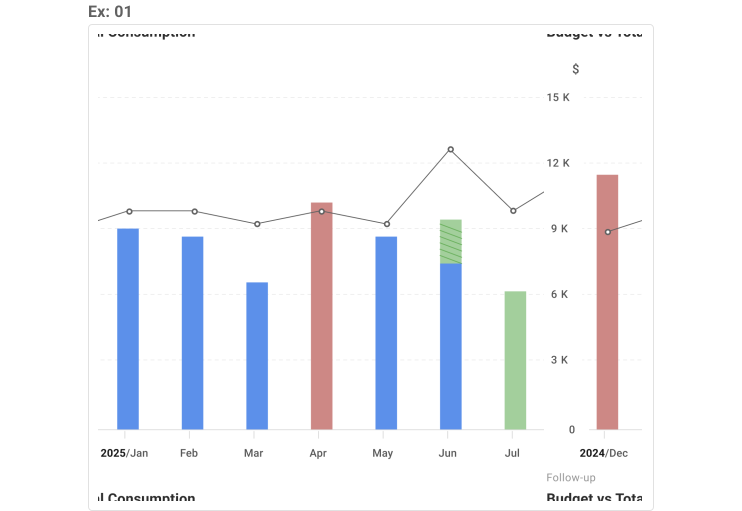
The graph helps to easily identify consumption in relation to the planned budget, represented by the orange bar, with the total consumption of cloud resources represented by the blue bar and the current month's consumption in light green. The forecast (estimated consumption for the current month) is shown in dark green.
When the month exceeds the forecasted value, the bar will turn red as shown in the example.
Example 01
-
2024 - December: Consumption exceeded the budget for the month.
-
2025 - January to August: Consumption was below the budget for the month.
-
2025 - June (current month): Consumption is below the forecast and budget for the month.
-
2025 - July (following month): We only show the forecast based on the calculation explained above.
Example 02
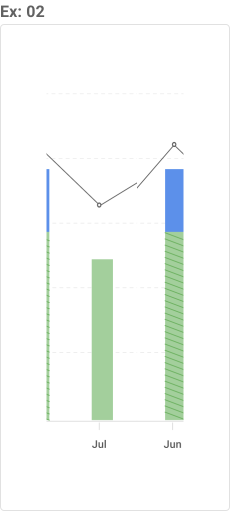
- June: Consumption exceeded the forecast, but did not exceed the budget for the month.
Example 03
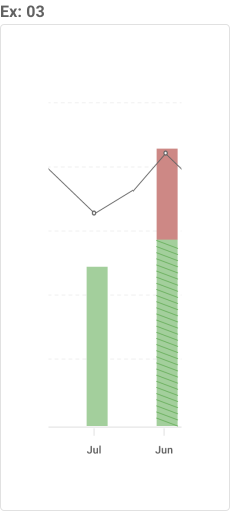
- June: Consumption exceeded both the forecast and the budget for the month.
Hovering the mouse cursor over the chart will exhibit the values by subject in the month.
When the user increases the period in the filter, the date markers will be more spaced out, but the value still represents monthly consumption, regardless of the selected interval.
To view consumption for a specific month, position the cursor over the line.
Chart for total spending above budget for cost center
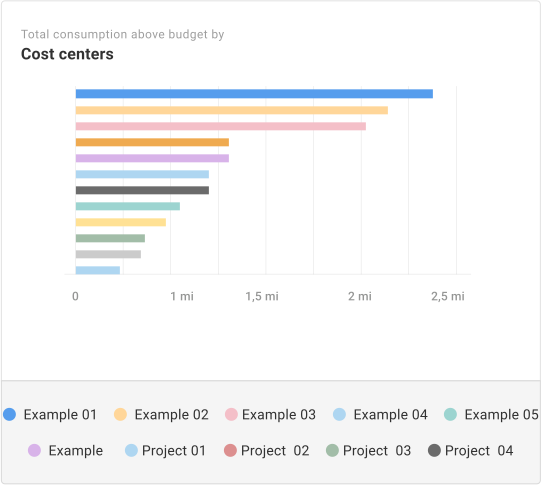
Here are grouped the cost centers that went over budget on the filtered period. Helping identify which areas are going beyond the specified financial limits, which allows a detailed analysis of the necessary adjustments to be made.
Chart for total spending above budget per manager
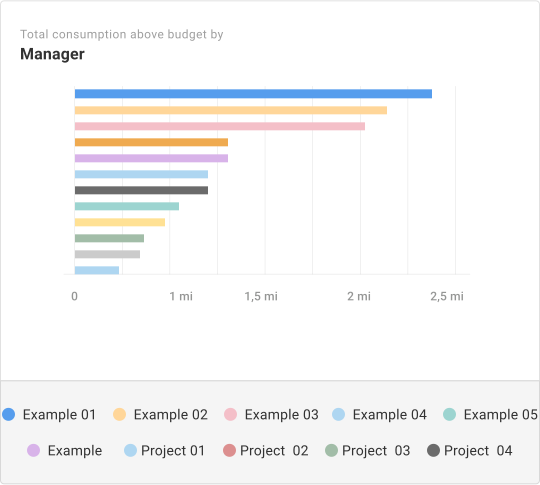
On this graph the managers responsible for the cost centers that went over budget on the filtered period are shown. This complements the graph with the costs for each cost center, making it easier to identify who is responsible for the financial excesses and apply the appropriate corrective actions.
Chart for total spending per manager
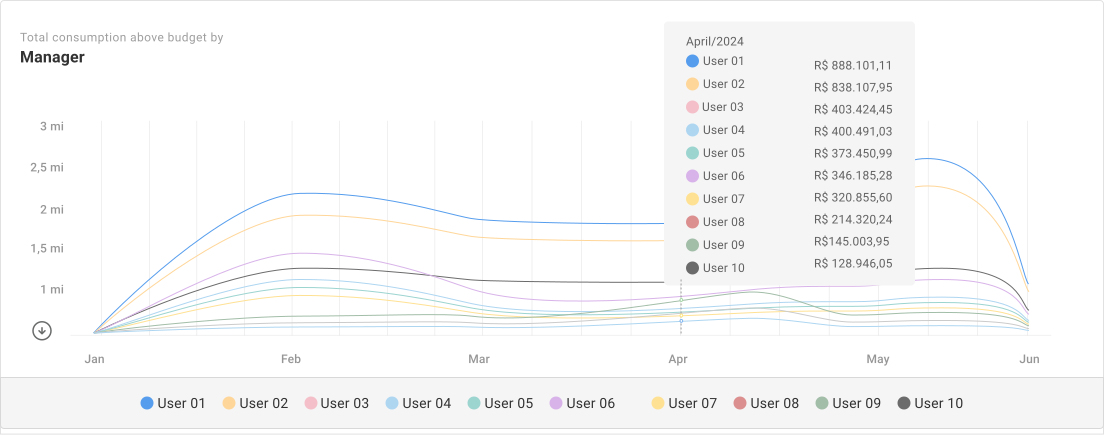
This chart presents the total consumption of resources of the cloud provider for each manager, regardless of whether they went over budget. It allows a visualization of the managers which are spending the most resources, facilitating monitoring and efficient expenditure management.